How we marketed an SDK by letting it market itself
A meta case study — using the Livepeer Agent SDK to produce its own marketing collateral, then showing the reader exactly how it was made.
Marketing a developer SDK to non-technical creatives is hard. The product is invisible. The mechanism is invisible. The value chain is invisible. Marketers reach for metaphors — "the AWS for AI media," "the rails," "the platform" — but metaphors slide off audiences whose day job is making things, not stitching them together. So we tried a different play: we used the SDK itself to make the marketing piece. Every visual on this page was rendered by an agent calling the same MCP a customer would call. The proof and the pitch are the same artifact.
The thesis
The Livepeer Agent SDK is built around one quiet idea: creative professionals already have AI agents. Claude, Cursor, ChatGPT, Cowork — they live in chat windows that creative pros use daily. What's missing is a creative substrate the agent can drive on their behalf — render an image, animate a still, build a moodboard, lock a brand kit, share a viewer URL — without the user learning a new app, a new SaaS, or a new pricing model. The SDK is that substrate.
The marketing problem then becomes a question of show vs tell. Most SDK marketing tells: "here's a docs page, here's a quickstart, here's a list of capabilities." A non-technical creative bounces off all three. We picked a protagonist, gave her a real morning, and let the agent render her workspace.
Meet Maya
Maya is a fictional but representative mid-30s marketing lead at an indie consumer brand. She has 30 minutes between meetings, an open laptop, and an AI agent in a sidebar window. Below is her launch morning, rendered as a six-scene cinematic storyboard. The agent extracted "Maya" as a character via Z2 (auto character_anchor), generated each scene through the Livepeer GPU mesh, and surfaced drift warnings on shots where her appearance drifted.
The storyboard — Maya's launch day in six beats

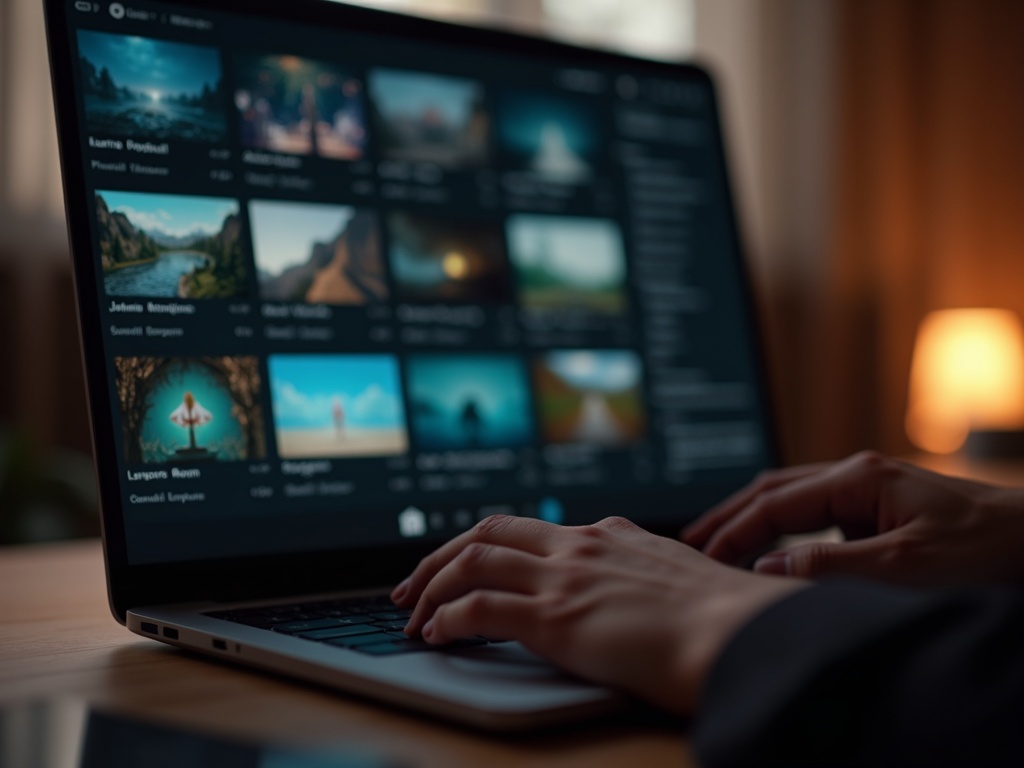



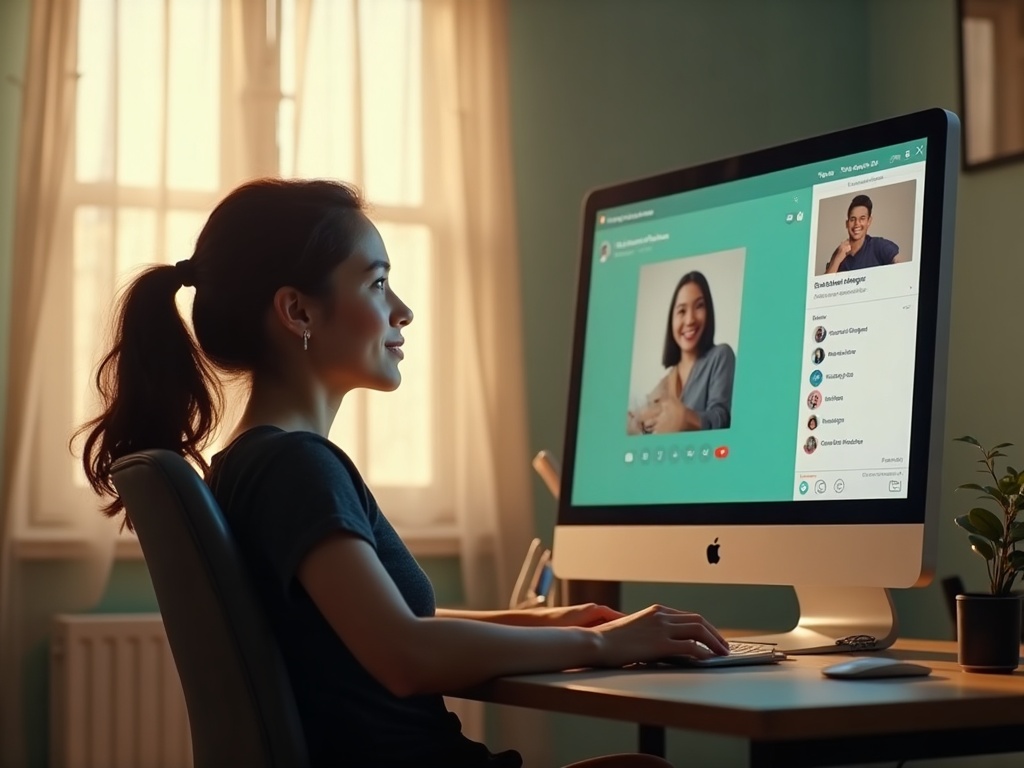
All six scenes rendered through flux-dev on the BYOC orchestrator. Five landed in 4–10 seconds; scene 5 was the outlier at ~13 seconds — exactly the kind of latency variance the AX-5 list_capabilities SLA metadata predicts (p50 ~6s, p95 ~20s). Live viewer: storyboard.daydream.monster/v/proj_744966e6d601
The animated episodes — same workspace, in motion
Once Maya saw the stills, the same chat moved fluidly into motion. One action: "animate" call per keyframe through seedance-i2v turned three stills into 5-second clips — the same surface she was already using, no new mental model to learn.
The moodboard — the breadth of who this is for
The storyboard answers "what does it look like for one user?" The moodboard answers "what does it look like for everyone?" Six slots, four image models rotated, all locked to the same brand kit (ckit_cba240449a). Each card hints at a different non-technical persona: brand director, indie filmmaker, comic creator, founder, educator, gallery curator. The agent didn't write six prompts — it briefed an intent ("eight visual cards each showing a different non-technical creative professional...") and the system varied the style cards.
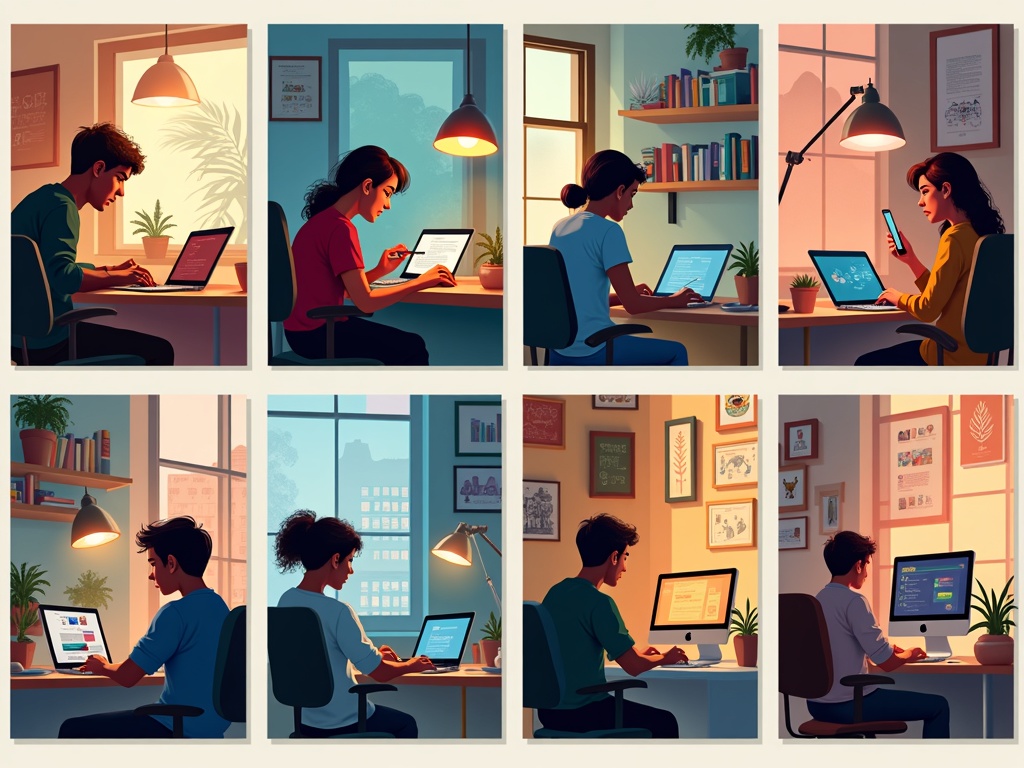
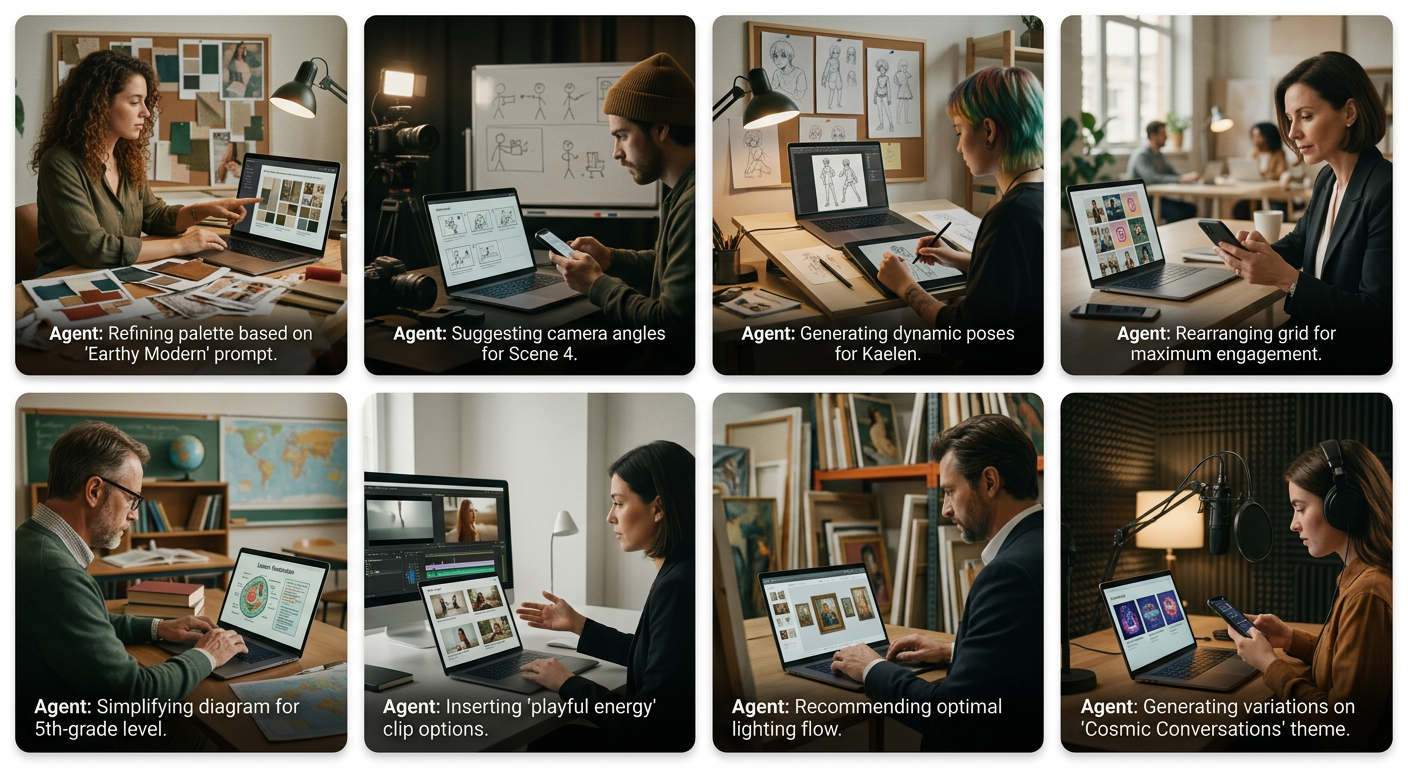
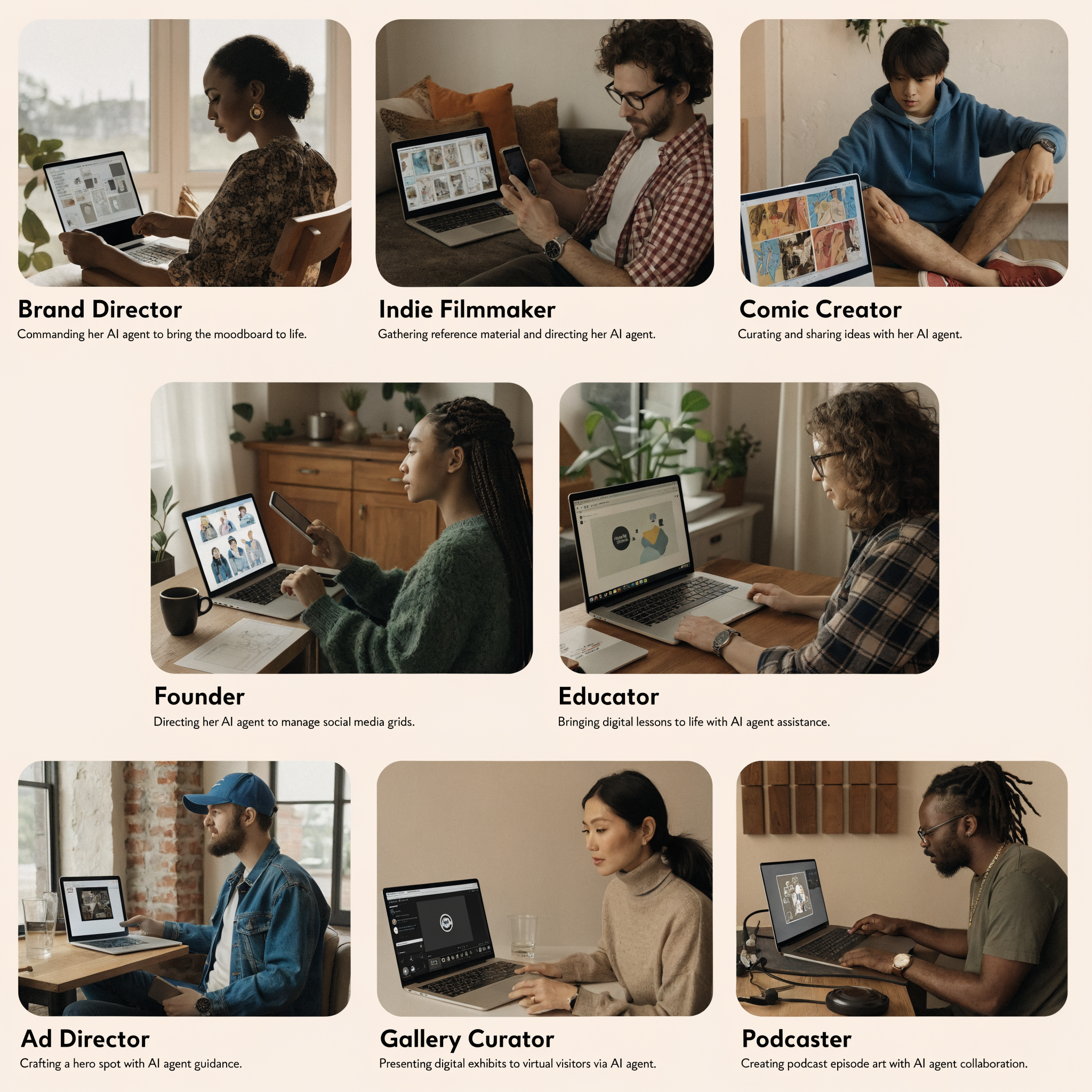
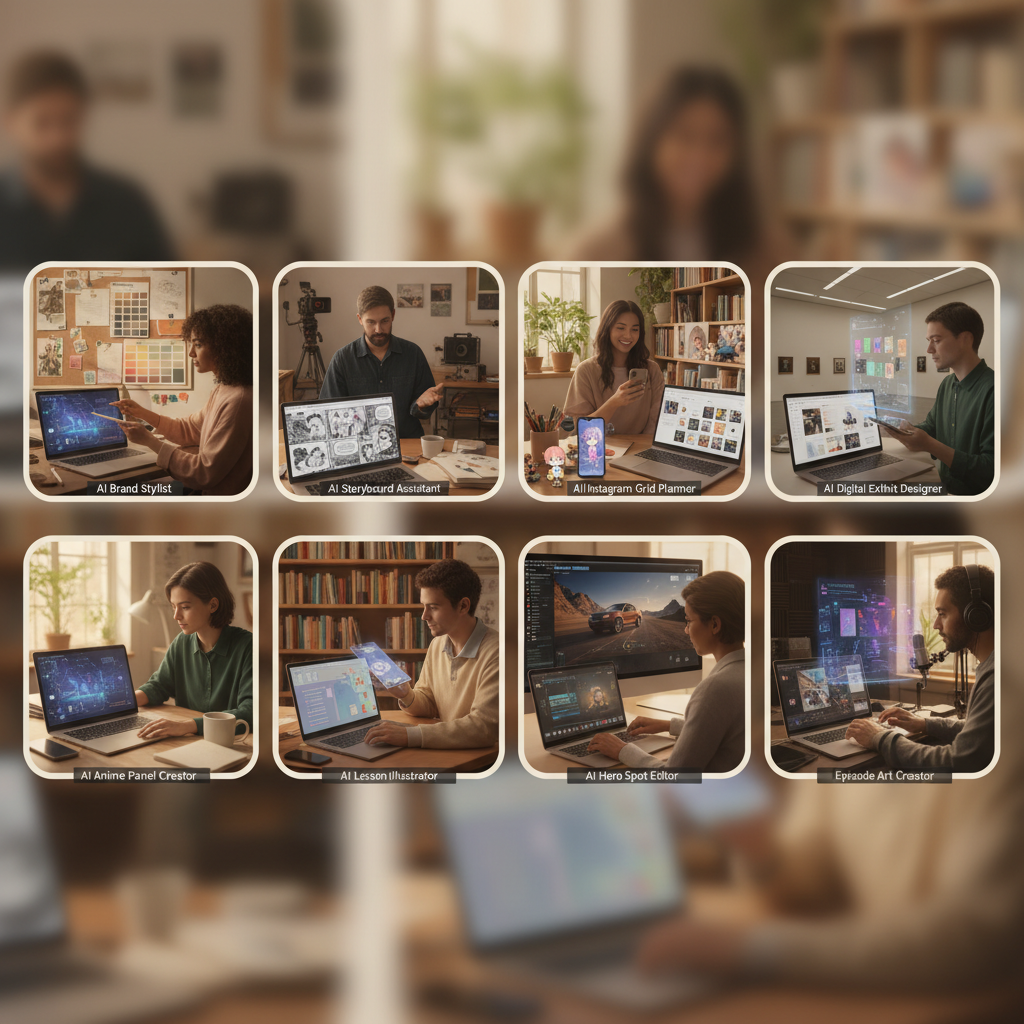

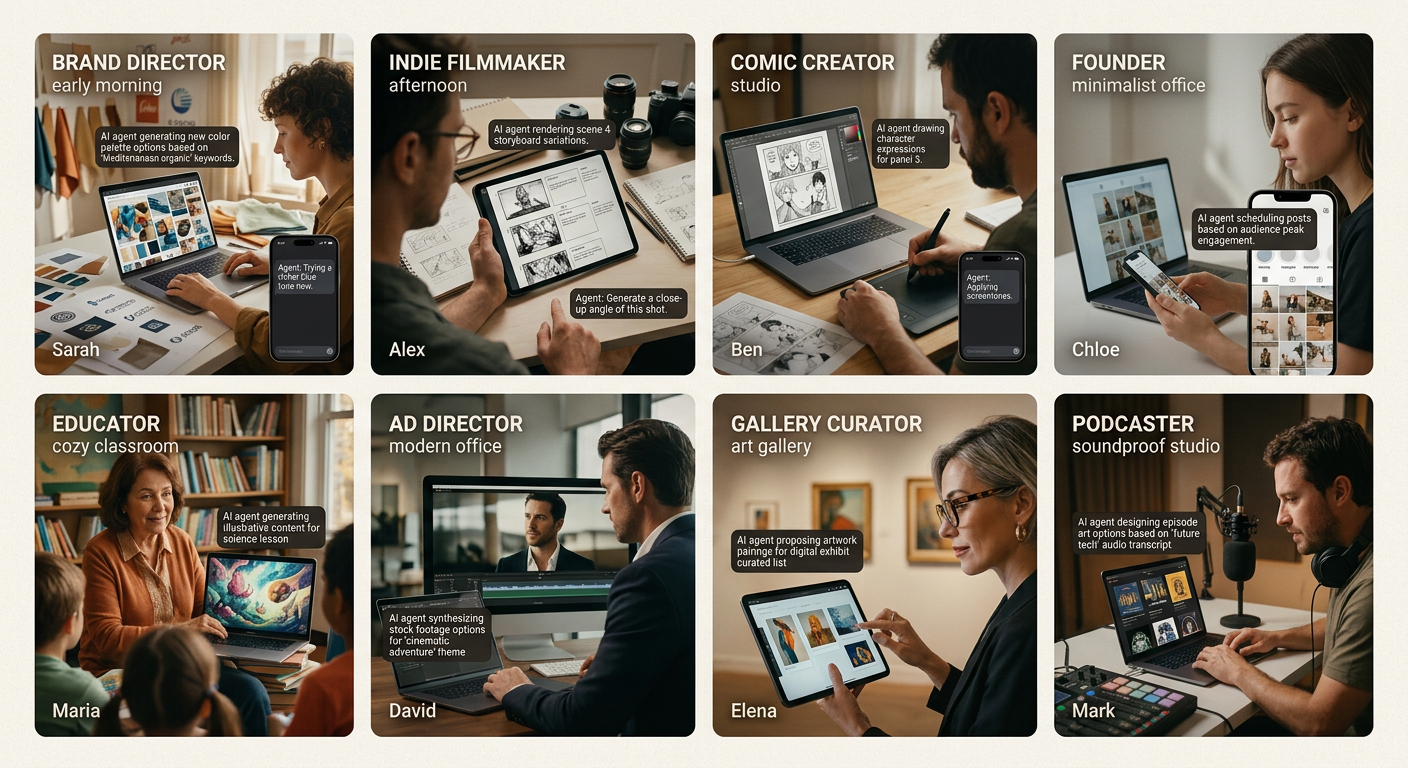
Public viewer (no login required): storyboard.daydream.monster/m/mood_407f47b1eb
What this whole page just proved (the meta-pitch)
The visuals above were rendered live. Not in advance, not by a designer, not by a studio. An agent — talking to one MCP server — produced them in roughly eight minutes for about two dollars of GPU compute. That is the product.
Re-read the storyboard and the moodboard with that frame, and the SDK's value proposition becomes concrete:
- Maya didn't pick the model. The router picked flux-dev for stills and seedance-i2v for motion based on the action. She didn't have to know what flux is, or what i2v means.
- Maya didn't manage cost. The agent applied
max_cost_usdper call (~$2 cap on the moodboard, ~$2 cap on the storyboard); the spend came in under both. - Maya didn't watch a queue. The agent polled
get_creative_jobbehind the scenes and surfaced progress when slots landed. - Maya didn't host a viewer. The MCP auto-published her board at a 14-day public-share URL she dropped into Slack.
- Maya didn't get gaslit on failures. Three things went non-happy-path in this session: (1) the first
moodboard_spreadat count=8 exceeded the 60s MCP client tool boundary — the agent retried with count=6, which fit. (2) Scene 5 took ~13s instead of the ~5s the others took. (3) The episode-3 animation hit a transient worker abort on the first attempt; the verbatim retry also aborted; the third attempt with a slightly simpler motion prompt succeeded. Each was a typed error envelope; the agent branched onretryableand either re-submitted, simplified scope, or trimmed cost. No silent failures, no fake "everything is fine."
The differentiators, in plain English
| Pillar | What it means for Maya | What it means under the hood |
|---|---|---|
| Built for agents | "I talk to my agent the way I already do. No new app." | 50+ MCP tools, typed errors, idempotency keys (AX-4), p50/p95 SLA metadata (AX-5), URL normalization (AX-6), notifications/progress streaming (Z7). |
| Human in the loop | "The system pauses for me at the moments that matter." | Z6 checkpoint primitive (pause/review/resume), Z3 drift gate (per-shot 0–1 score with reasons), confirm: false cost-preview dry runs. |
| Decentralized GPU network | "Pricing isn't hostage to one cloud. I see USD up front." | Livepeer BYOC mesh, dynamic price discovery, transparent cost_usd_estimated per call, max_cost_usd hard cap pre-flight. |
| Cross-surface | "Same key works in CLI, in MCP, in the browser. Same artifacts." | Storyboard browser parity (Z1.5), CLI parity (Z+AX track), MCP server first; bearer-portable across surfaces. |
The playbook — how this case study works as marketing
Pull this apart for your own SDK marketing:
- Pick a non-technical protagonist. Not the engineer. Not the buyer. The end-user-of-the-end-user. Render their morning, not your architecture diagram.
- Eat your own dog food, visibly. Your visuals are the proof. If the page itself was made by your product, the case study is the demo.
- Surface cost + time. "~8 min, ~$2" is a clearer pitch than "best-in-class throughput."
- Show failure honestly. Three things slipped in this session (moodboard timeout, scene-5 latency, episode-3 abort) and each is documented above. A perfectly polished demo reads as a perfectly polished demo; one with a documented retry path reads as a real product.
- Anchor to the agent the user already has. Maya isn't installing a new app; her existing Claude/Cursor agent calls a new tool surface. The lift to adopt is one config line.
Cite-only comparison — how this kind of pitch lands vs alternatives
Cited from each vendor's public marketing material as of mid-2026. We did not render the same brief on these platforms.
| Marketing surface | Livepeer Agent SDK (this page) | OpenAI Platform marketing | Anthropic API marketing | Runway / Flora landing pages |
|---|---|---|---|---|
| Protagonist is a non-technical creator | ✓ Maya, marketing lead | Engineer-first ("build with GPT") | Engineer + AI safety researcher | Creator-first ✓ |
| Visuals are produced by the product | ✓ Every image on this page | Stock photography | Stock photography | Curated highlight reel |
| Cost surfaced explicitly | ✓ "~$2" | Per-token pricing table | Per-token pricing table | Subscription tiers, not per-use |
| Time-to-result surfaced | ✓ "~8 min" | "Real-time" | Latency benchmarks | "Instant" |
| Agent-callable framing | ✓ "Your agent calls our MCP" | "Use the API" | "Use the API" | "Use our app" |
| Open network framing | ✓ Livepeer mesh, transparent pricing | OpenAI-only cloud | Anthropic-only cloud | Vendor cloud |
| Honest failure trace | ✓ "Scene 5 didn't land" | Rare in marketing | Rare in marketing | Rare |
What we'd do next
- Persona series. Maya is one of eight. Run the same play for the comic creator (the Lantern Apprentice case is the comic creator), the filmmaker (Grandpa Tom), the founder (Lumen Wellness), the brand director (Pure North). Each piece reinforces the others.
- Live render embed. Replace one static image with a live
moodboard_spreadthat runs when the reader visits the page. Cost: ~$0.50 per visitor; the value is "the page makes itself in front of you." For high-intent traffic only. - Voice-over hero clip. Take the three animated episodes, mux audio via
create_media action=mux_audio, narrate Maya's morning with chatterbox-tts. ~$1, ~3 min, one more MCP call. - Cost-and-time tracker. Surface live "agents on Livepeer right now" alongside the case study as a marketing artifact — proof of network breadth.
Try it yourself
Point your agent (Claude Cowork, Cursor, ChatGPT desktop, OpenHands) at storyboard.daydream.monster/api/mcp. Bring a Daydream API key. Run the three calls Maya used — brand_kit_create, generate_project, create_media action=animate. Your morning, rendered.
Live artifacts from this run: Personas moodboard · Maya storyboard