The Lighthouse BirdAn original six-panel webtoon, generated from a 180-word short story
Paste a short story into the playbook, choose webtoon mode, get a vertical-scroll webtoon you can post to Webtoon Canvas, Tapas, or any social feed. The story-to-screen playbook breaks an arbitrary story into N visual panels, locks the cast across every frame, and burns narration into Cormorant Garamond caption bands the same way published webtoons do. This example is an original short story written for the playbook itself — Mira, a girl in a lighthouse, finds a wounded gull and her grandfather Tobin teaches her to heal it.
The story — written specifically for this playbook, ~180 words
The playbook explicitly refuses to render text from copyrighted works verbatim — if a user pastes a published novel, the agent stops and asks them to paraphrase. The example here is an original short story written for the playbook, so the showcase pipeline can be reproduced end-to-end with no IP exposure. Bring your own story (your own writing, a public-domain text, or a paraphrase) and the playbook works the same way for it.
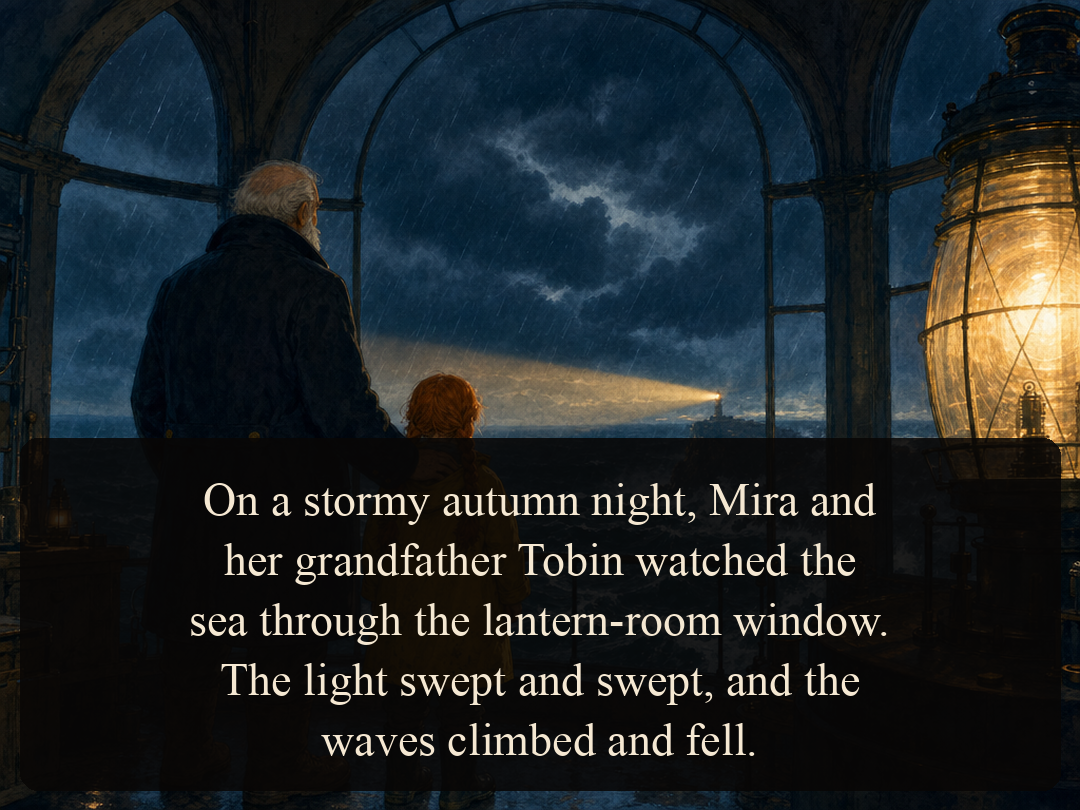
On a stormy autumn night, Mira and her grandfather Tobin watched the sea through the lantern-room window. The light swept and swept, and the waves climbed and fell.
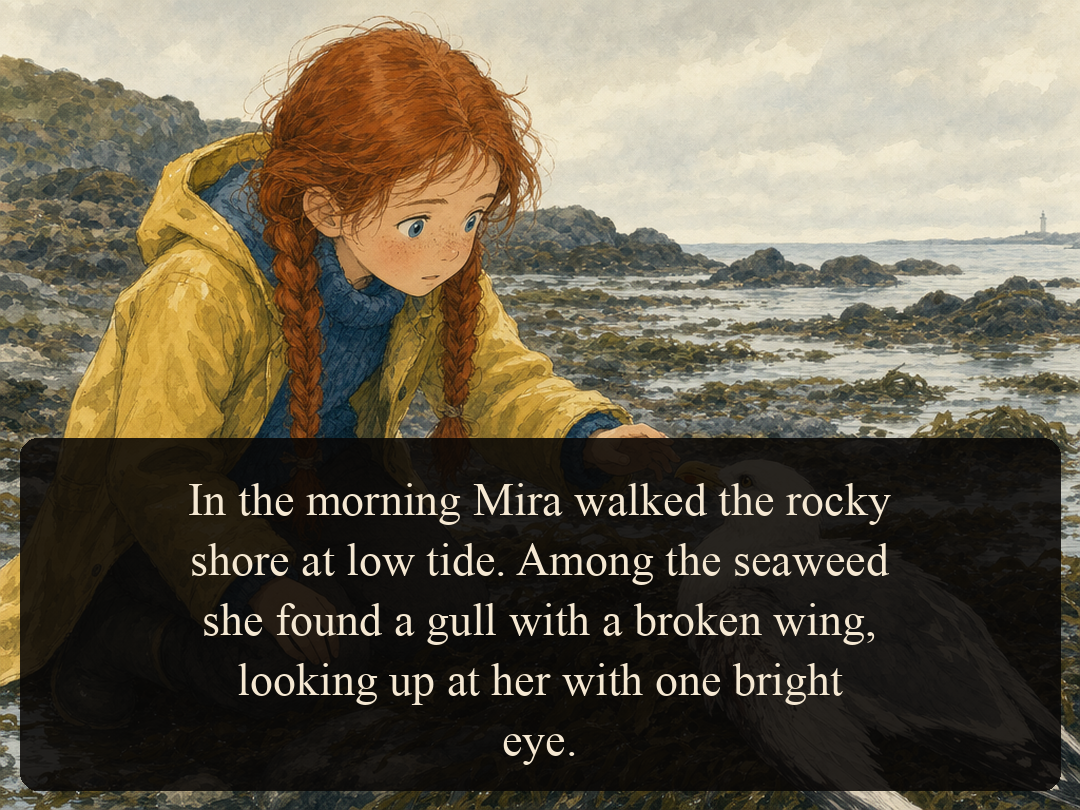
In the morning Mira walked the rocky shore at low tide. Among the seaweed she found a gull with a broken wing, looking up at her with one bright eye.
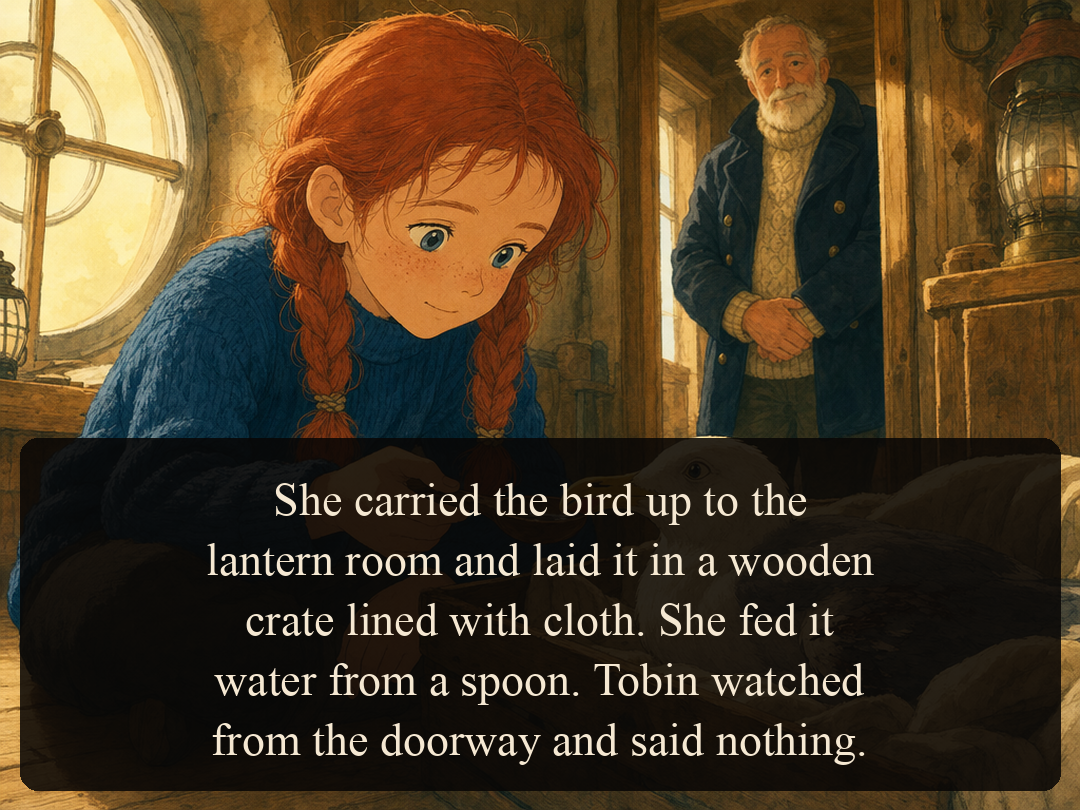
She carried the bird up to the lantern room and laid it in a wooden crate lined with cloth. She fed it water from a spoon. Tobin watched from the doorway and said nothing.
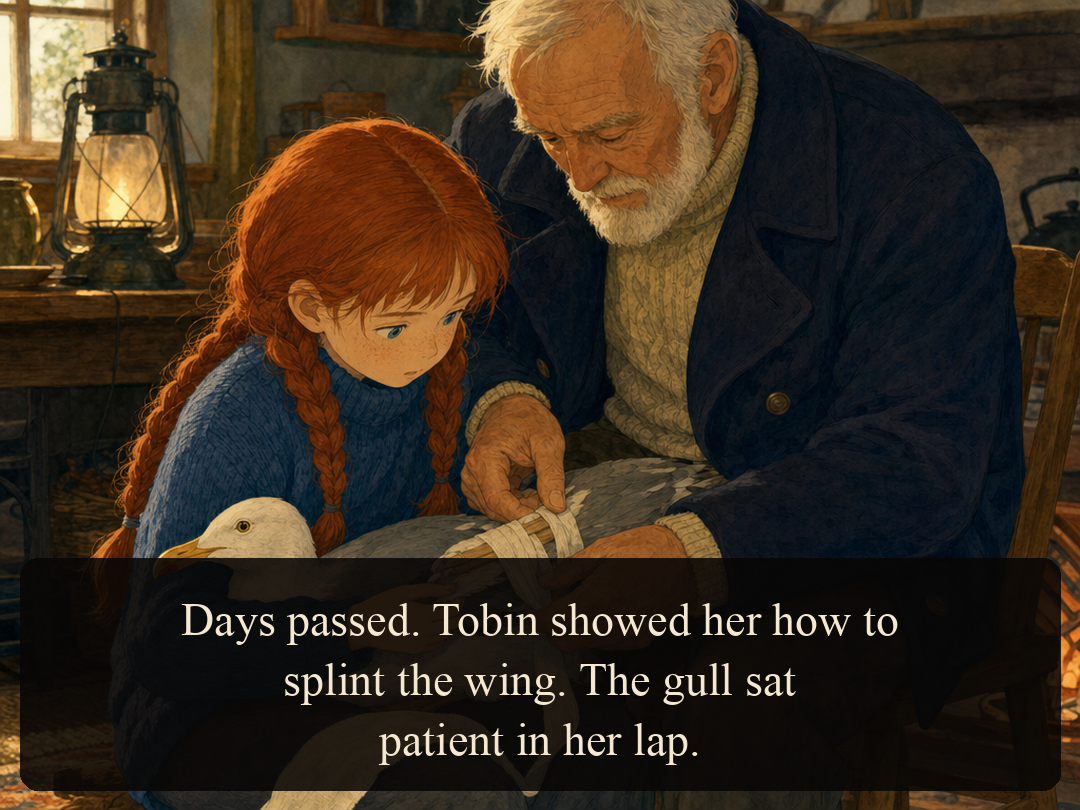
Days passed. Tobin showed her how to splint the wing. The gull sat patient in her lap.
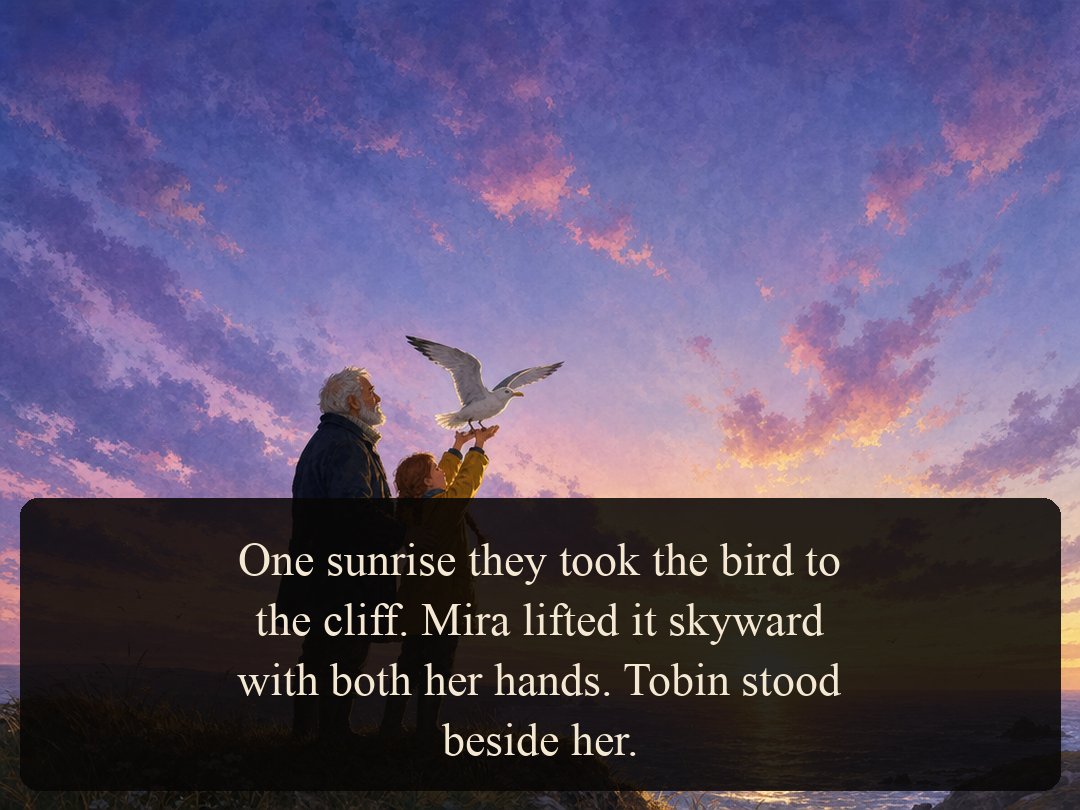
One sunrise they took the bird to the cliff. Mira lifted it skyward with both her hands. Tobin stood beside her.
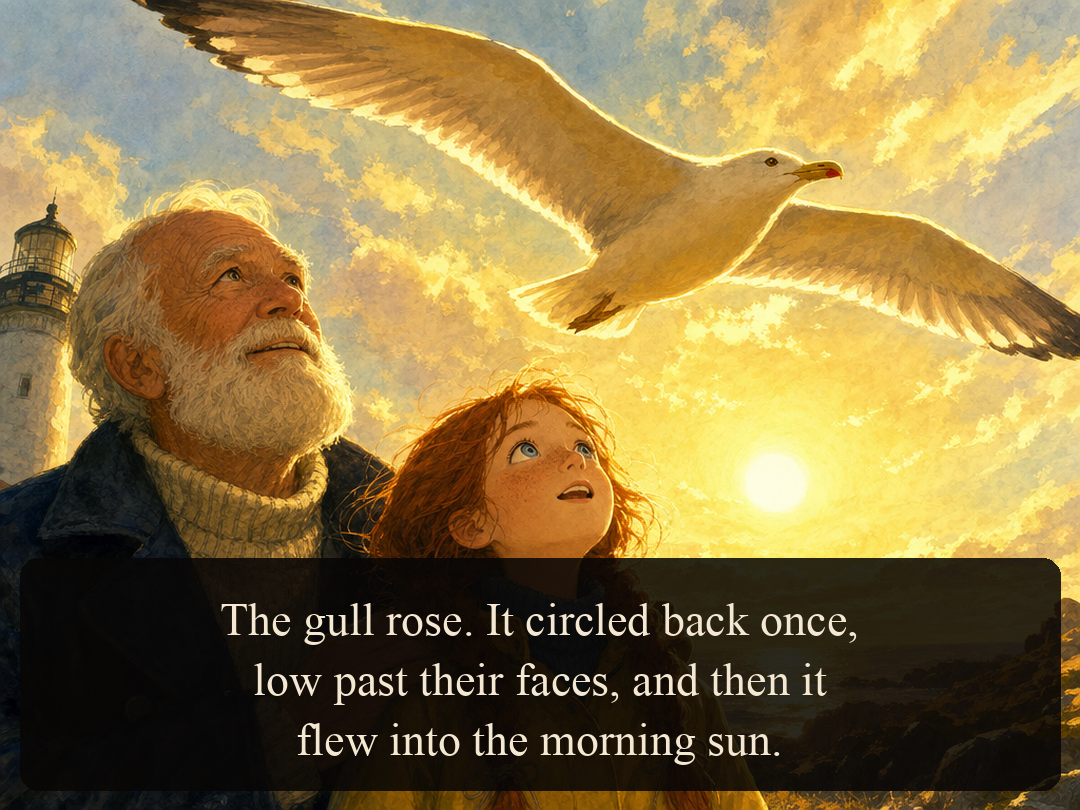
The gull rose. It circled back once, low past their faces, and then it flew into the morning sun.
The cast — locked verbatim across every panel
The most important quality control in story-to-screen is the character constant block: the same ~30-word physical spec is re-pasted into every panel prompt, never abbreviated to "Mira (see above)". This is the difference between a coherent webtoon and a six-panel parade of similar-looking strangers. The playbook embeds these specs into every create_media call automatically.
Style brief — the single style sentence pasted into every prompt
A single visual-language sentence appears verbatim in every keyframe prompt, prefixed before the scene-specific clause. This is what keeps watercolor light direction, color palette, and brush quality consistent across all six frames.
Quality controls applied for this run — the gates the playbook ran before any keyframe fired
The playbook's pre-render gates (A1–A6) are where most of the quality is won. The five tables below are what the agent surfaced to the user as ONE approval gate, before spending a single dollar on generation. Each row directly shapes one or more of the panel prompts above.
A1 · Cast bible — multi-axis spec (not a one-liner)
The single most common cause of character drift is an underspecified cast. Each character is locked across 5 axes (identity_anchor, face, wardrobe, expression, silhouette). The identity_anchor opens every prompt mention of that character because the model anchors strongest on the first ~10 tokens of an entity description.
face: round head, two thick rust-red braids tied with twine, wide alert blue eyes, pale freckled skin, sun-pinked cheeks
wardrobe: thick blue wool fisherman's sweater + yellow oilcloth raincoat (hood down) + dark grey wool trousers + scuffed rubber wellingtons
change_policy: SAME CLOTHING across every panel
expression: attentive, gentle, watchful
silhouette: small upright figure, braids visible from any angle
face: weather-tanned skin, short-cropped white beard and mustache, kind crinkled eyes
wardrobe: cream wool fisherman's sweater + navy peacoat + dark wool trousers + worn brown leather boots
change_policy: SAME CLOTHING across every panel
expression: quiet, patient, watching from doorway distance
silhouette: tall stocky figure, white beard visible from any angle
A2 · Beat sheet — every panel has an explicit dramatic role
The agent does not pick N evenly-spaced moments; it tags each panel with a beat role. The role constrains the camera, the framing, the lighting, and the emotional dial without extra prompt engineering.
A3 · Shot grammar — forced cinematic variety
AI image models repeat compositions if left alone. 6 evenly-prompted panels often come back as 6 variants of "medium two-shot, eye-level". The agent forces variety: at least 1 wide / 2 medium / 2 close / 1 detail-or-environmental across 6 panels.
A4 · Color script — palette evolves with the arc
A locked style ≠ a static palette. The agent traces a 6-step palette evolution: cool storm → cool discovery → warm shelter → warm bonding → cool-to-warm sunrise → full golden release. The style sentence stays constant; the per-panel palette accent shifts.
A5 · Continuity state matrix — what's true in which panel
A small table the agent maintains so prop / wardrobe / character-state continuity holds across panels. Each ✓ becomes a positive flag injected into the panel prompt ("gull's left wing splinted"). Each — becomes a negative when forgetting it would cause drift ("no splint — the gull is now free").
Pipeline trace — from pasted story to scrollable webtoon
Stage 1 — approval gate (cheap, your attention only) User reviews the 6-panel breakdown + cast spec, redirects any scenes.
Stage 2 — keyframe wave (parallel fanout) 6 ×
create_media action=generate, model=gpt-image, aspect=9:16 → 6/6 done
Each prompt: [style brief] + [verbatim cast spec] + [scene-specific clause]
Stage 3 — mid-render contact-sheet review Agent surfaces all 6 panels in chat for visual sanity check. Any off-style / off-character panel can be re-fired for ~$0.20 here.
Stage 4 — caption-band burn-in (local Python + Pillow) For each panel, render a translucent rounded-corner band with the narration text in Cormorant Garamond serif (46pt cream-on-shadow), composited onto the bottom 18-22% of each panel. Output:
webtoon-01.png … webtoon-06.png
Stage 5 — page assembly (this HTML page) Vertical-scroll layout, panels stack edge-to-edge like Webtoon native. Single-column 1080-wide column, ready for Webtoon Canvas / Tapas upload.
Quality guards applied throughout ✓ Cast spec re-pasted verbatim into all 6 prompts (no "see above") ✓ Style sentence identical across all 6 prompts ✓ Keyframe prompts forbid signs / banners / readable text in image ✓ Caption text added at Pillow stage, NEVER in the AI render ✓ Original story text (no copyrighted prose passed through)
Cost — end-to-end run
Reproduce with your own story — the playbook is open
This webtoon was built from the story-to-screen playbook. Same 5-stage pipeline works for any short story up to ~2,000 words, any style (Ghibli watercolor, Pixar 3D, inked manga, Mucha art-nouveau, pixel-art JRPG), any panel count from 4 to 16. Paste your text into the YAML brief, choose webtoon mode, and the agent does the rest. ~$1.20 and ~10 minutes later you have a webtoon scroll page like this one.
Want the same story as an animated reel with narration and music instead? See the animated video example — same 6 panels, same cast, same style, but Ken-Burns-animated with a warm storyteller voice-over and an instrumental score.