The Lighthouse BirdAn original short story, animated into a 60-second narrated reel
Paste a short story into the playbook, choose animated-video mode, get a vertical reel with a warm storyteller voice-over and a unified instrumental score. The story-to-screen playbook breaks an arbitrary story into N visual beats, locks the cast across every frame, generates the panels, animates each one with real kling-v3-i2v motion under strict B9 motion-budget discipline (one element moves per panel, cast faces hold still), narrates the prose to time, scores it gently, and stitches the whole thing into a TikTok / YouTube Shorts / Instagram Reels-ready MP4. This example is an original short story written for the playbook itself — Mira, a girl in a lighthouse, finds a wounded gull and her grandfather Tobin teaches her to heal it.
The story — original prose, narrated to time
The playbook explicitly refuses to render text from copyrighted works verbatim — published novels, song lyrics, and named-scripture quotes all stop at the brief stage. The example here is an original short story written for the playbook so the entire pipeline can be reproduced safely. Bring your own writing or a public-domain text and the playbook works the same.
For animated-video mode, the narration script is broken so each ~10 seconds of voice-over aligns with one panel. Times below match the rendered 60s reel.
The six panels — locked cast, locked style, six visual beats
Each panel below is a single keyframe that goes through real kling-v3-i2v animation for 10 seconds under strict B9 motion-budget discipline: each i2v prompt allows exactly ONE element to move (a wing stretch, a hand reach, a wind in the braids), with explicit "faces and bodies hold PERFECTLY STILL" clauses to mitigate face drift. That's how you get real animation across 6 panels without losing character identity. The kling output normalizes to ~4:3 regardless of the source aspect, so we composite each clip onto a 1080×1920 vertical frame using its own heavily-blurred copy as the background fill (standard TikTok / Instagram landscape-in-vertical trick) — full motion preserved, zero distortion.
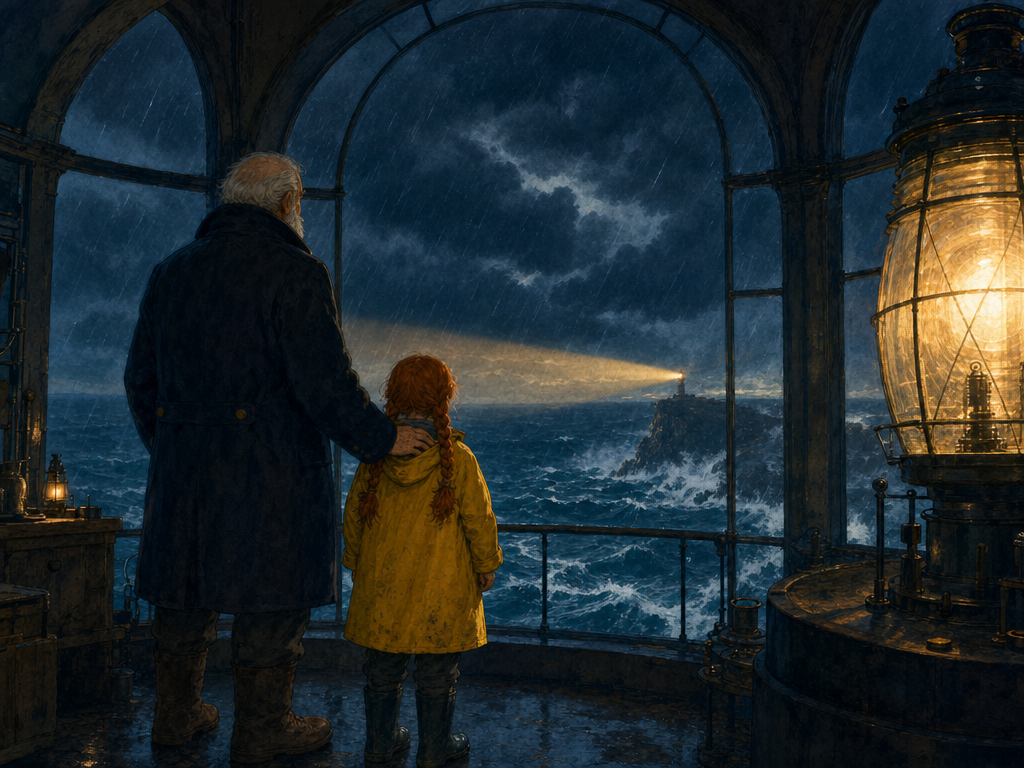
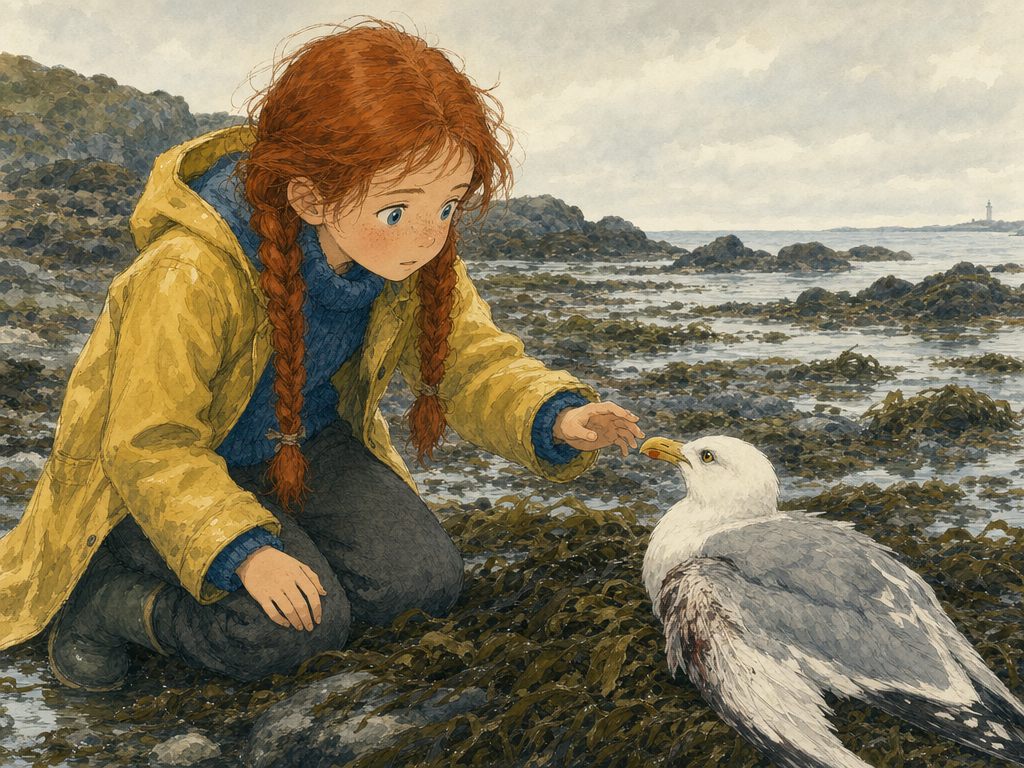
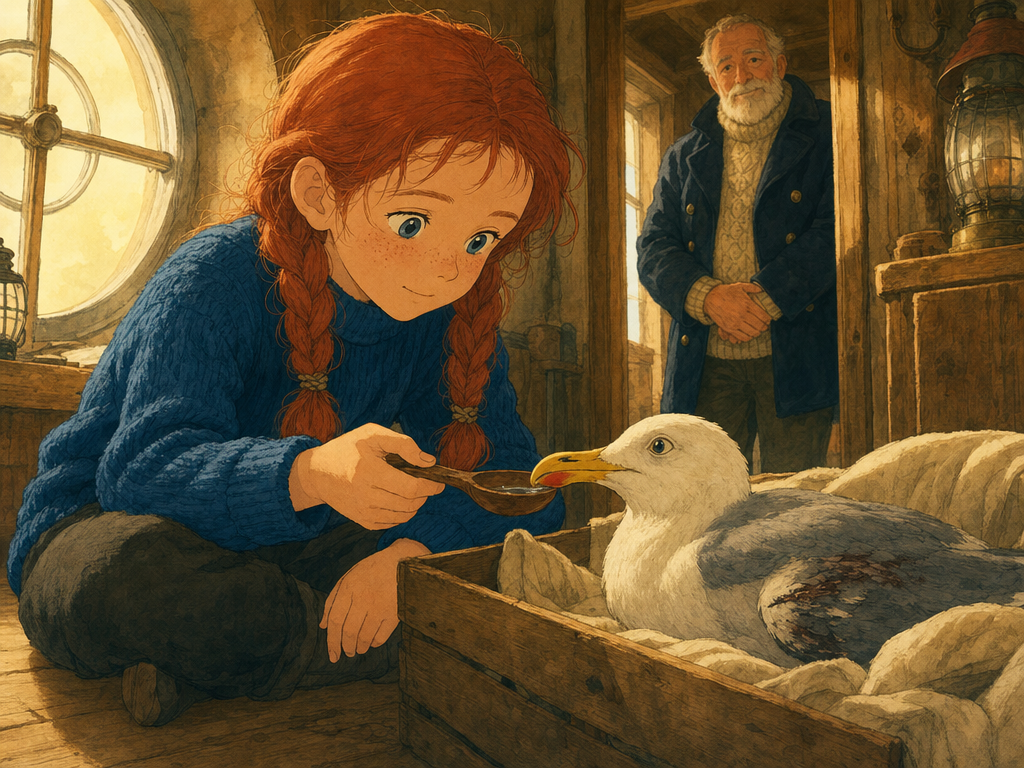
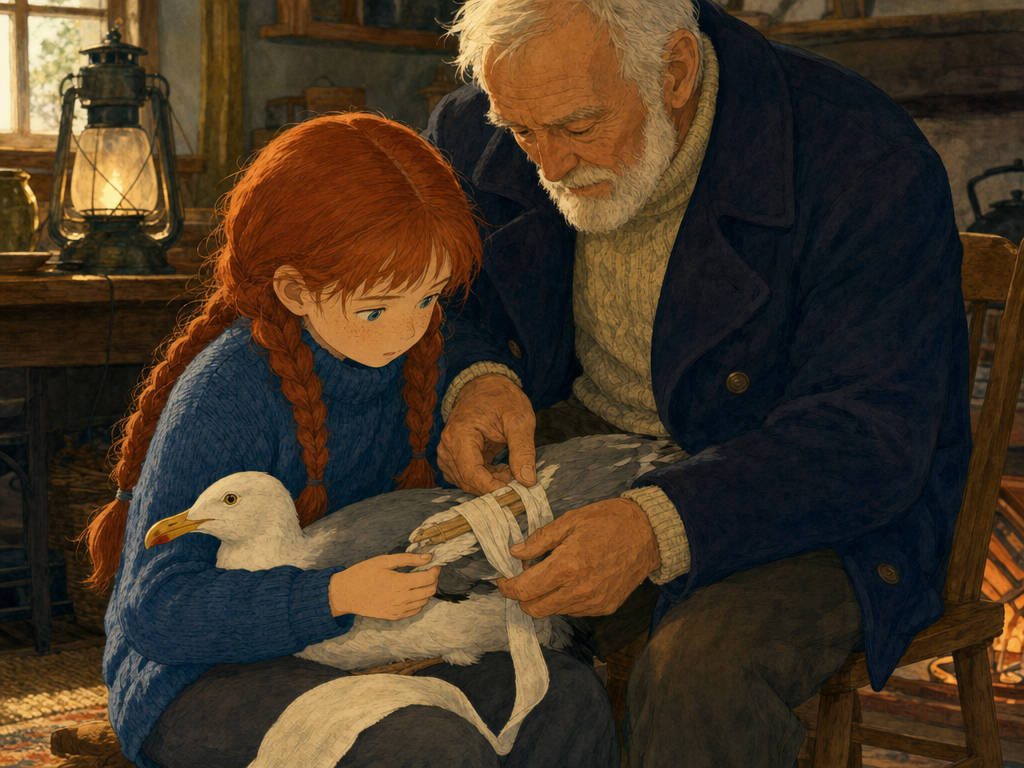
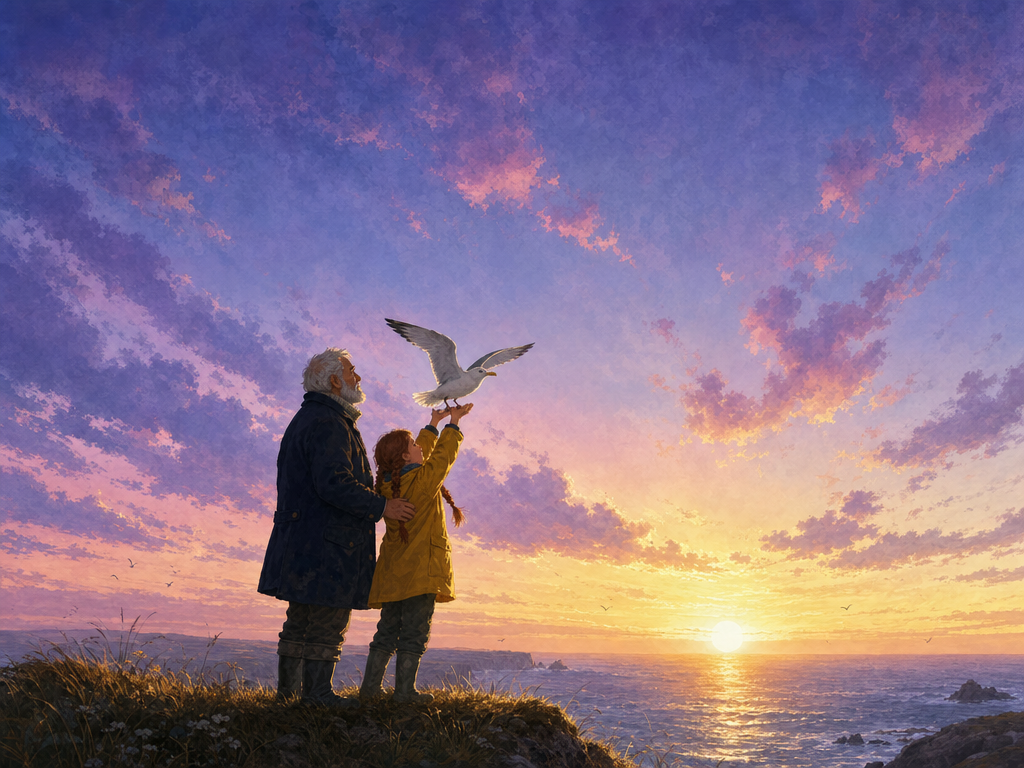
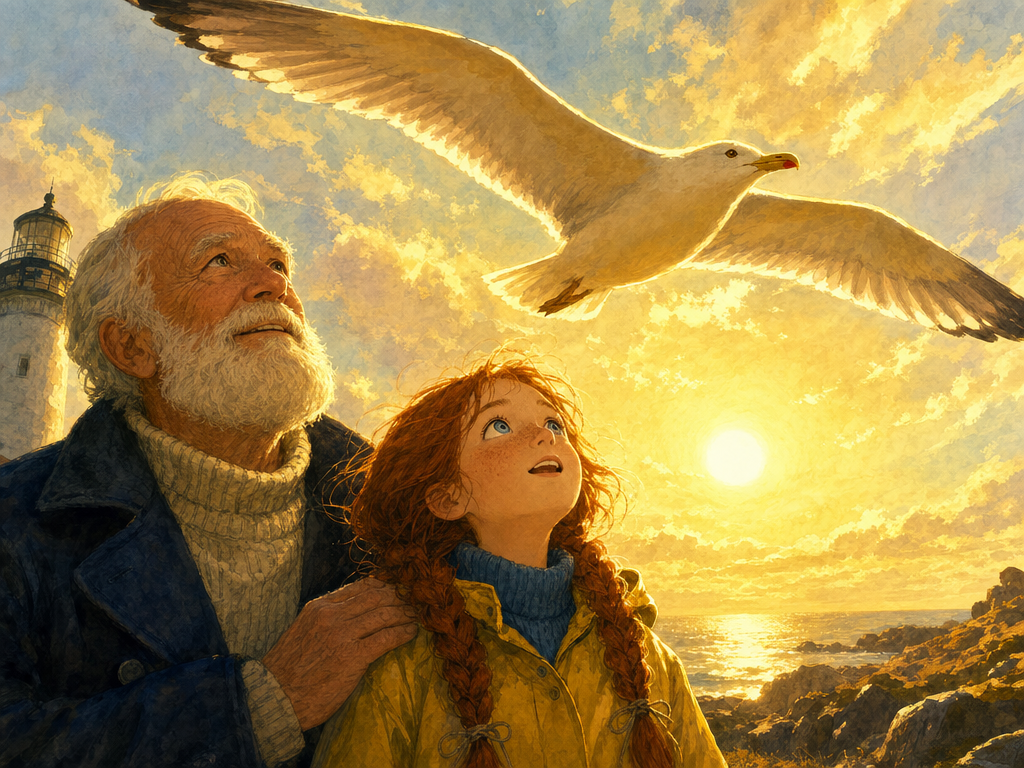
The cast — locked verbatim across every panel
The most important quality control in story-to-screen is the character constant block: the same ~30-word physical spec is re-pasted into every panel prompt, never abbreviated to "Mira (see above)". This is the difference between a coherent reel and a six-panel parade of similar-looking strangers. The playbook embeds these specs into every create_media call automatically.
Voice-over & music — warm storyteller + intimate Ghibli-tier piano
Voice-over brief: warm female storyteller, slow contemplative pace, soft and tender — like reading a bedtime story. The agent uses gemini-tts with a "Gacrux" voice profile; no specific celebrity / personality referenced. Music brief: solo piano + soft strings, intimate Studio-Ghibli-tier score, builds gently from contemplative open to warm major-key release in the closing 10 seconds, no vocals. Both are mixed: voice 1.0 / music ducked to 0.18 so the words always sit on top of the bed.
Quality controls applied for this run — the gates the playbook ran before any keyframe fired
The playbook's pre-render gates (A1–A6) are where most of the quality is won. Cast bible + beat sheet + shot grammar + color script + continuity matrix are bundled into ONE approval gate, surfaced to the user before any expensive generation. Each row directly shapes one or more of the panel prompts.
A1 · Cast bible — 5-axis spec, not a one-liner
The single most common cause of character drift is an underspecified cast. Each named figure is locked across 5 axes (identity_anchor, face, wardrobe + change_policy, expression, silhouette). The identity_anchor opens every prompt mention because models bias on the first ~10 tokens of an entity description.
face: round head, two thick rust-red braids tied with twine, wide alert blue eyes, freckled skin
wardrobe: thick blue wool sweater + yellow oilcloth raincoat (hood down) + dark wool trousers + rubber wellingtons
change_policy: SAME CLOTHING across every panel
expression: attentive, gentle, watchful
silhouette: small upright figure, braids visible from any angle
face: weather-tanned, short-cropped white beard and mustache, kind crinkled eyes
wardrobe: cream wool fisherman's sweater + navy peacoat + dark trousers + worn brown leather boots
change_policy: SAME CLOTHING across every panel
expression: quiet, patient, often watching from doorway distance
silhouette: tall stocky figure, white beard visible from any angle
A2 + A3 · Beat sheet × shot grammar — every panel has a dramatic role AND a cinematic role
Beat role constrains the emotional dial. Shot grammar enforces cinematic variety — AI models will repeat compositions unless told otherwise, so the agent forces at least 1 wide / 2 medium / 2 close / 1 detail across 6 panels.
A4 · Color script — palette evolves with the arc
A locked style ≠ a static palette. The agent designs a 6-step palette that traces COOL → WARM as the story moves from tension to release. The style sentence stays constant; the per-panel palette accent shifts.
A5 · Continuity state matrix — props and conditions per panel
Each ✓ becomes a positive flag injected into the panel prompt ("gull's left wing splinted with linen"). Each — becomes a negative when forgetting it would cause drift ("no splint — the gull is now free"). The matrix is what keeps the gull's injury, the splint, and the release timing all coherent.
B4 · Deterministic prompt assembly template — same field order every panel
Every panel prompt is assembled in the same order, so the model sees a stable shape across all 6 calls. The deterministic order is itself a quality control — it removes prompt-craft variance between scenes.
Pipeline trace — from pasted story to finished reel
Stage 1 — approval gate (cheap, your attention only) User reviews the cast spec, scene breakdown, narration script. Redirect anything.
Stage 2 — keyframe wave (parallel fanout) 6 ×
create_media action=generate, model=gpt-image → 6/6 done
Each prompt: [style brief] + [verbatim cast spec] + [scene-specific clause]
Stage 3 — i2v animations + voice-over + music (all 8 in parallel) 6 ×
create_media action=animate, model=kling-v3-i2v, duration=10 → 6/6 done in ~2 min
each prompt: B9 motion-budget — ONE element moves per panel, faces hold steady
1 × create_media action=generate, model=gemini-tts (Gacrux voice) → 57.8s done
1 × create_media action=music, model=minimax-music, piano + strings → done
Stage 4 — vertical-fit + concat + audio mix (local ffmpeg) Kling output is 1108×828 (4:3) regardless of source aspect. To ship 9:16: [bg] : split source, scale-to-cover 1080×1920, crop, boxblur=40 [main]: scale source to 1080 wide (= 808 tall, full 4:3 visible) overlay main centered onto blurred bg → 1080×1920 vertical, no distortion Concat 6 fitted clips (60.0s) and mix audio: voice @ 1.0 + music @ 0.18 (ducked under the narrator) afade in 0–0.4s, afade out at 58–60s output:
the-lighthouse-bird-reel.mp4 (~28MB · H.264 · AAC 192k · 60s)
Quality guards applied throughout ✓ Cast spec re-pasted verbatim into all 6 keyframe + all 6 i2v prompts ✓ Style sentence identical across all 6 keyframes ✓ B9 motion-budget — ONE moving element per i2v call, cast-lock clause ✓ Keyframe prompts forbid signs / banners / readable text in image ✓ Blurred-fill vertical fit — no aspect distortion, all motion preserved ✓ Voice-over timed to 10s-per-panel beats (no rushed reading) ✓ Original story text (no copyrighted prose passed through)
Cost — end-to-end run
Reproduce with your own story — the playbook is open
This reel was built from the story-to-screen playbook. Same 4-stage pipeline works for any short story up to ~2,000 words, any style (Ghibli watercolor, Pixar 3D, inked manga, Mucha art-nouveau, pixel-art JRPG), any panel count from 4 to 16, any narration voice from gemini-tts. Paste your text into the YAML brief, choose animated-video mode, run. ~$8 and ~10 minutes later you have a reel like this.
Want the same story as a vertical webtoon scroll instead? See the webtoon scroll example — same 6 panels, same cast, same style, but with caption boxes burned into each panel for vertical-feed reading.