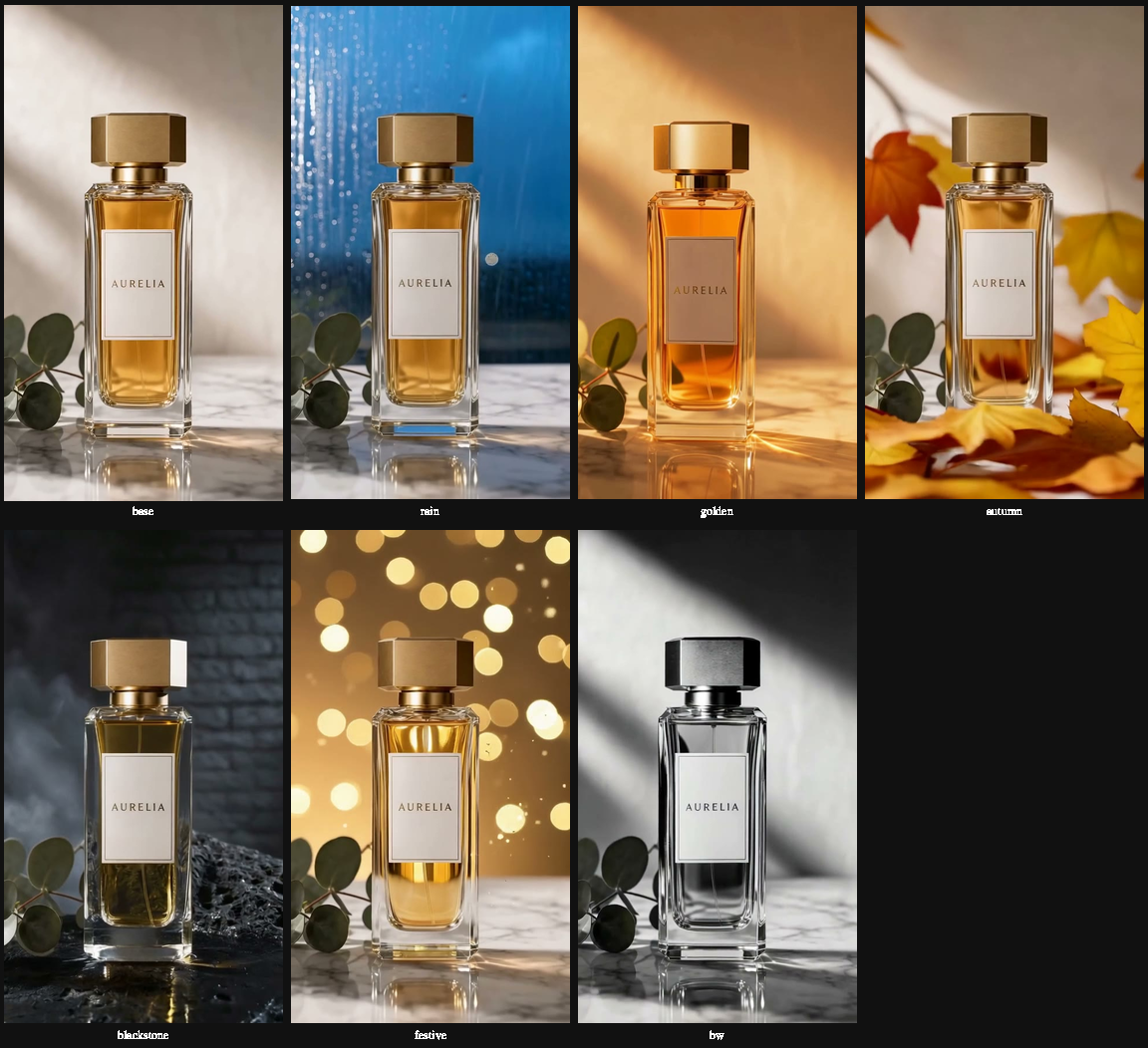
AURELIAone hero shot · six scene-locked worlds
You don't re-shoot for rain, for golden hour, for a different season. You shoot once — and instruction-edit the same frame into every world, the bottle and the brand staying exactly where they were.
Same scene, instruction-driven
One studio hero of the AURELIA bottle, animated into a slow push-in. Then six Bernini-R instruction edits — each changing exactly one thing while the bottle, the gold cap, the AURELIA label, and the composition stay identical. This is the format pure-generative tools can't make: not six new scenes, but one scene, six ways.
The edit matrix
Each is a single instruction on the same base clip. Look across the row: the product never moves; the world does.
BASE
Marble · soft studio
EDIT 01
Rainy evening
EDIT 02
Golden hour
EDIT 03
Autumn
EDIT 04
Black volcanic stone
EDIT 05
Festive gold
EDIT 06
Editorial B&W
How it was made
gpt-image → AURELIA hero (legible label)→
seedance-i2v → base push-in→
bernini-r-edit ×6 (parallel) → the worlds→
ffmpeg → matrix reel + per-platform
The six edits ran in parallel (~9 min wall, not 45 serial). Bernini-R is the marquee: one model that both generates and edits video, scene-preserving, guided by instructions + up to 5 reference images.
Honest verdict
✓ What held
- 6 / 6 scene-locked — bottle, gold cap, eucalyptus, and composition identical across every edit.
- The AURELIA label stayed legible across all six (better than typical for AI edits).
- Each edit changed exactly the instructed thing — weather, light, season, surface, mood, or grade.
⚠ What to watch
- Bernini runs ~7–8 min/edit and exceeded a hidden 5-min timeout chain — we fixed it (proxy + a
body.timeoutthe request was missing) before this render was possible. - Brand text can drift on heavier edits — keep a post step ready to restore the wordmark.
- fal flakes ~10–20%; budget one retry per ~6 edits (all six landed first-try here).